Tuesday, December 16, 2008

It Isn't Fair Pt. 2

Last week we discussed some of the issues and rights under the Fair Credit Reporting Act. Now, we can continue the discussion.

Below is an expert from a little booklet called Making the Most of Your Credit Report: Your personal guide. This booklet is put out by Kroll Background America, Inc. who is the largest backround investigation company in America. They also are one of the leading credit repositories used in providing Tri-merge credit reports for mortgage lenders, credit card companies and auto lenders.

It is critical in understanding our credit, what our rights are regarding the reporting of our credit history. Please take the time to review this information to gain more understanding as you learn to manage your credit more efficiently.


Consumer reporting agencies must correct or delete inaccurate, incomplete, or unverifiable information. Inaccurate, incomplete or unverifiable information must be removed or corrected, usually within 30 days. Keep in mind that any verified information the consumer reporting agency verifies as correct may continue to be reported.

Consumer reporting agencies may not report outdated negative information. In most cases, 7 years is the maximum amount of time for consumer credit tradelines. Some Bankruptcies may continue on the report for up to 10 years.

Access to your file is limited. A consumer reporting agency may provide information about you only to people who have a valid need. These needs include applications with creditors, insurance requests, landlords or other business. Under the FCRA, verification of the specific need is required for access.

You must give your consent for reports to be provided to employers. A consumer reporting agency is restricted from giving out any information about you to an employer or potential employer without written consent from you. The trucking industry is generally exempt from written consent. For more information, go to http://www.ftc.gov/credit.

You may limit "prescreened" offers of credit and insurance you get based on information in your credit report. Unsolicited "prescreened" offers for credit and insurance must include a toll-free phone number you can call if you choose to remove your name and address from the lists these offers are based on. You may opt out with the nationwide credit bureaus at 1-888-5 Optout (1-888-567-8688).

You may seek damages from violators. If a consumer reporting agency, or, in some cases, a user of consumer reports or a furnisher of information to a consumer reporting agency violates the FCRA, you may be able to sue in state or federal court.

Identity theft victims and active duty military personnel have additional rights. For more information, visit http://ftc.gov/credit.

There is a lot to know about understanding your rights under the Fair Credit Reporting Act. However, you should never feel overwhelmed if you have a trusted advisor you work with who knows the information or can access it very easily.

If you would like to discuss this more, you're more than welcome to contact me at jchristensen@legacymortgagenm.com.

Monday, December 1, 2008

Shopping? Protect Your Identity

Well the holiday shopping season is upon us once again. This is the time of year when we are thinking about the people we love most. What in the world are we going to get for each of them. Some are easy and some are so incredibly hard to shop for. Don't worry, there is still plenty of time and plenty of ways to get your shopping done.

Please keep in mind that this is also the time of year when Identity Thieves are out looking for their latest victims. While you're out doing your shopping this year, please keep in mind some very simple things to protect yourself and your identity.

1. Your Trash is NOT Garbage... To these ID thieves, trash is a treasure chest of vital information that many unsuspecting people throw away. Be careful to shred your unwanted mail and solicitations that may have your vital information like social security numbers, birthdays, name spelling, address, and phone numbers. It doesn't take much for an ID thief to become a new person. Treat your Trash like a Treasure and this will thwart many thieves. To opt out of receiving pre-screened offers of credit in the mail, call 1-888-5-OPT-OUT (1-888-567-8688). You will be asked to provide your Social Security Number, which the consumer reporting companies need to match you with your file.

2. Mail outgoing bills and parcels in Post Office collection boxes...make sure to remove your mail from your mail box promptly so thieves don't riffle through looking for a new ID. If you're planning on being away during the Holidays, contact the Postal Service at 1-800-275-8777 or online at http://www.usps.gov to request a vacation hold. The Post Office will hold your mail at the local office until you can pick it up or are home to receive it.

3. Be on guard using the Internet to do your shopping...Every year, more and more people are using the internet for their Holiday shopping to avoid the crowds at the malls and to save themselves time. The internet also never closes, so shop til you drop in your PJ's if that's your joy. However, be aware of the scammers and ID thieves lurking on the net. For some practical tips to protect your personal information, visit http://www.OnGuardOnlinve.gov.

4. Be aware while at the Register...While you are out shopping, more and more of the stores now allow a quick swipe of credit and debit cards at the register. Be aware of wandering eyes that may be watching for a PIN entry. Also, keep alert to cashiers who may be acting funny as they process your transaction. If you suspect any kind of strange activity, report it immediately to the store manager.

5. Protect your wallet and purses...Many of us carry large wallets and purses with us while out shopping. In those wallets and purses are the very items many thieves are looking for. Consider leaving the wallet or purse in the car or at home when entering a store. Secure only the cash, ID, and/or credit card in your pocket while shopping to make it more difficult for a thief to swipe your entire ID vessel of choice.

6. Identity Theft Insurance...ID Theft Insurance will not deter a thief, however, it can in many circumstances minimize any loss associated with ID Theft. Things to consider when looking into ID Theft Insurance are 1) the amount of coverage the policy provides, 2) whether it covers lost wages, 3) the amount of deductible, if any, 4) any exclusions to the policy (is the thief a family member), 5) does the policy provide a counselor to help resolve the problems of id theft, and 6) Does your homeowner's policy already contain some provision for ID Theft (if so, how much will your premiums be affected if used. The biggest "cost" of ID theft is the time you will spend cleaning up your credit and recovering your identity.

Personally, I spent 4.5 years cleaning up my credit and my wife's credit after a box of checks was stolen from our home in 1998. It nearly cost us approval on our first home. 36 checks, 135 collection accounts, $39.95 for credit reports every 4 months for 4.5 years, and a day in court to convict the thief later we got it all cleaned up.

Consider an Identity Theft protection like Identity Theft Shield, which will do all the work for you when a theft occurs. I wish I had this when I went through the mess. For only $12.95 per month, they take the worry out of clean up. http://www.prepaidlegal.com/hub/christensenj

Have a safe Holiday Season!

Saturday, November 29, 2008

But it isn't Fair...part 1


Unfortunately, finding information about credit reports was not so easy up until 3 years ago. Coming from a back ground of Banking and Mortgage Lending, I can tell you that the general rule of thumb when advising clients about credit was there are no rules. Credit agencies were not regulated to disclose how they determined a consumer's credit score. It was a complete mystery. Much Trial and Error occurred in advising clients in those days. Now, since the passing of the Fair Credit Reporting Act, information is readily available, but many lenders still guess rather than taking the time to master the information in a credit report.

Below is an expert from a little booklet called Making the Most of Your Credit Report: Your personal guide. This booklet is put out by Kroll Background America, Inc. who is the largest backround investigation company in America. They also are one of the leading credit repositories used in providing Tri-merge credit reports for mortgage lenders, credit card companies and auto lenders.

It is critical in understanding our credit, what our rights are regarding the reporting of our credit history. Please take the time to review this information to gain more understanding as you learn to manage your credit more efficiently.

A Summary of Your Rights Under the Fair Credit Reporting Act

The federal Fair Credit Reporting Act (FCRA) promotes the accuaracy, fairness, and privacy of information in the files of consumer reporting agencies. There are many types of consumer reporting agencies, including credit bureaus and specialty agencies (such as agencies that sell information about check writing histories, medical records, and rental history records.) Here is a summary of your major rights under the FCRA. For more information, including information about additional rights, go to www.ftc.gov/credit or write to: Consumer Response Center, Room 130-A, Federal Trade Commission, 600 Pennsylvania Ave. NW, Washington, DC 20580.

You must be told if information in your file has been used against you. Anyone who uses a credit report or another type of consumer report to deny your application for credit, insurance, or employment - or to take another adverse action against you - must tell you, and must give your name, address, and phone number of the agency that provided the information.

You have the right to know what is in your file. You may request and obtain all the information about you in the files of a consumer reporting agency (your "file disclosure"). You will be required to provide proper identification, which may include your social security number. In many cases, the disclosure will be free. you are entitled to a free file disclosure if:

  • a person has taken adverse action against you because of information in your credit report;
  • you are the victim of identity theft and place a fraud alert in your file;
  • your file contains inaccurate information as a result of fraud;
  • you are on public assistance;
  • you are unemployed but expect to apply for employment within 60 days.

In addition, as of September 2005, all consumers are entitled to one free disclosure every 12 months upon request from each nationwide credit bureau and from nationwide specialty consumer reporting agencies.

See www.ftc.gov/credit for additional information.

You have the right to ask for a credit score. Credit scores are numberical summaries of your credit worthiness based on information from credit bureaus. You may request a credit score from consumer reporting agencies that create scores or distribute scores used in residential real property loans, but you will have to pay for it. In some mortgage transactions, you iwll receive credit information for free from the mortgage lender.

You have the right to dispute incomplete or inaccurate information. If you identify information in your file that is incomplete or inaccurate, and report it to the consumer reporting agency, the agency must investigate unless your dispute is frivolous.

See www.ftc.gov/credit for an explanation of dispute procedures.

Please stay tuned for Part 2 coming soon to a blog near you...

Wednesday, November 26, 2008

Did Junior Steal My Credit?


Oh Boy! I'm sure you've seen this happen. You're at the coffee pot Wed. morning and your co-worker comes in with a look of disgust on his face. When you ask what happened, you wish you had politely stepped out of the room.

He starts in about how irresponsible his youngest son is with his money, and don't get started on that little girl friend of his...Oh no! Anyways, he went in to apply to buy a new car yesterday with his eyes on that shiney red Mustang he has always wanted. You know the one. Anyways, when they pulled up his credit, a slew of collection accounts and late payments showed up that he knew nothing about. After a little further investigation, he found out they belong to Jr.

I can't begin to tell you how many times I've seen this happen over the years. I've seen it benefit young kids who didn't have any credit, but mom or dad's good credit showed up in their name allowing them to obtain the credit they needed. Mostly, I've seen it have an adverse affect.

Believe me when I tell you, it's not always the child's fault. I've seen kids with excellent credit hurt by their deceased parents' bad credit or their parents' bruised credit.

The most common way this happens is with a Jr. or Sr. situation. Dad has to have his son named after him. Believe it or not, I had it happen more than once with a daughter who shared a mother or grandmother's name.

This is probably one of the most common credit reporting errors that occurs. It is not always easy to get corrected. The issue the credit bureaus have to decide is which one actually owns the credit? This has to be documented and proven to the credit reporting agencies to clarify who gets to claim the tradeline.

Mixed credit does exist in credit bureau data. A parent and adult child who share the same or similar names may develop mixed credit. This is compounded by sharing the same residence address or by having shared a prior residence address. (NOTE: Using suffixes with a name such as John Doe Jr. or John Doe III, as well as your birth date, may assist in eliminating mixed data).
The best advice I can offer is to fill out all credit applications very legibly, since this is where the credit bureaus obtain their information. Second, if you don't have to name your child with your name, avoid it. Let your child have his or her own identity. Please don't take that the wrong way. I mean it purely in the sense that our society has become very dependent on computers to keep track of information. The computer is only as good as the data going in.

Finally, if this is a big problem, you may want to consider a Credit Repair program. To get more information about credit repair, visit my link to "Fix Credit Now" in the link section of this blog (top right side). You can also click on the title to this article.

I hope this is helpful information. Remember, it is not a life threatening problem, but it can cause a lot of inconvenience if it does occur in your life. Best of luck out there.

Joshua Christensen, CMPS (c)

(505) 250-1944

Monday, November 24, 2008

Identity Theft


Today, Identity Theft is becoming the fastest growing crime in America! All someone needs is a social security number to steal your identity. What kind of protection do you have?

Click on the title of this post to watch a quick video explaining the importance of protecting your identity. This is a growing concern for all of us in America. You can also paste this link in your browser http://www.youtube.com/watch?v=mvauin8J43U&feature=related.

You're working hard to manage your credit. You should not have to work so hard to protect your identity. Let me explain.

Belinda (my wife) and I have personally had our identity stolen twice in the last 10 years. One in the form of stolen checks and the other our debit card number. The stolen checks created a 4 year mess every time we applied for new credit due to collection accounts that showed up every 2-4 months. I had to order my credit from all 3 bureaus and dispute 10-15 new collection accounts 3-4 times a year. I also had to go out to the creditors with the collections to give them copies of my afidavits and the police report proving the theft was legit. I spent hundreds of dollars and countless hours over 4 years working on this problem. I don't recommend this for anyone to go through.

Watch this video and if you would like more information on how you can sign up for Identity Theft Protection, please click on the link in the top right corner of this blog "Identity Theft Site".

Thank you. Protecting your credit and your identity go hand in hand. Have a fantastic day!

Joshua

Credit Scores and Home Loans


Did you know that the great Real Estate Bubble that we experienced over the last several years was littered with people buying Investment Properties and 2nd Homes? About 45% of all the home loans written between 2003 and 2007 were rentals and 2nd homes. Another 23% came in the form of Sub-Prime loans for people with bruised and severely damaged credit.

Today, foreclosures are rising at record levels, with a large number of the loans in default coming from the Sub-Prime market and the investment arena. As a result, lenders are in a position of raising their rates to offset their risk associated with the loan requests.

If your credit is damaged, expect to pay more for your home loan. Please look at these examples:

Brother A and Brother B both work for the same company in the same job with the same salary. Brother A did a great job of managing his credit and maintains a 720+ credit score. Brother B on the other hand carries high credit card balances in relation to his credit limits causing his score to be 640.

These two brothers want to live in the same neighborhood and actually like the same model home. they are both purchasing a $200,000 home with a 5% down payment. So how does the difference in their credit affect their cash flow?

Brother A
$190,000 loan amount 7.0% $1,264 Principal/Interest Payment $106 PMI

Brother B
$190,000 loan amount 7.5% $1,329 Principal/Interest Payment $143 PMI

Brother B will pay $101 per month more than Brother A and will pay $6,974 more in the first 5 years of the loan.

As you can see, managing your credit can save thousands over time. It has never been more important than it is today as lenders are pricing their loans based on their risk.

If your credit score is below 720, you may pay a premium for different loan types, credit cards, and insurance products. I recommend you take the time to Repair your Credit to save yourself thousands of dollars in all areas of your financial portfolio. Click on the link Fix Credit Now to get started.

In 90 days or less, you can be on your way to much better financing and saving thousands of dollars in unnecessary interest charges.

Credit Score Basics


Credit Reporting is one of the most mis-understood services in our financial lives. Up until a couple of years ago, the credit repositories were not legally obligated to disclose what or how they came up with credit scores. I worked in retail banking and made the mistake of guessing what my clients needed to do to improve their scores.

Perhaps you or someone you know was advised to close a credit card account thinking it would be good, but your credit score got worse. Why? Hopefully the following definitions will help you have a better understanding of your credit report and how different activity can have a dramatic affect on your score. By clicking on the title to this article, you can visit the www.myfico.com credit education site for more information.

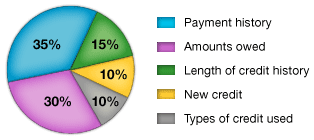
First, it is important to understand that your credit score is a only snapshot of your credit profile at any given point. Any credit activity will change the score as indicated below.

  1. 35% of Score - Payment History: How well do you pay your credit obligations on time?
  2. 30% of Score - Amounts Owed: Are your credit cards maxed out?
  3. 15% of Score - Length of Credit History: How long have your accounts been open?
  4. 10% of Score - Types of Credit: How diverse are the types of credit you use?
  5. 10% of Score - New Credit: Doe you apply for credit frequently?
By understanding these basics and thinking about how they all correspond with one another, you can gain understanding into better management of your credit score and save your self money on future credit.